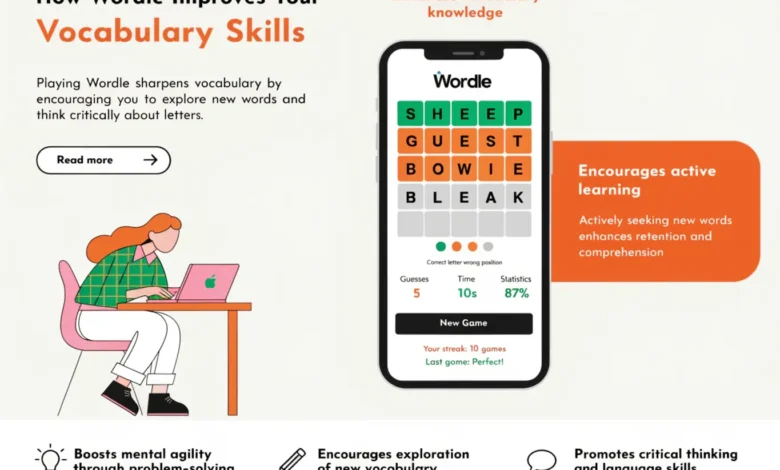
At first glance, Wordle appears to be a straightforward word puzzle: guess a five-letter word in six attempts using color-coded feedback. Yet beneath its simplicity lies a surprisingly powerful mechanism for language learning.
Since its global rise in popularity, educators and cognitive scientists have begun to recognize Wordle as more than entertainment. It functions as a micro-learning tool that engages memory, pattern recognition, and linguistic intuition—all essential components of vocabulary development.
In 2026, as digital learning continues to evolve, Wordle stands out as a rare example of a game that is both addictive and educational.
The Science Behind Vocabulary Growth
Active Recall Strengthens Memory
One of the most effective ways to learn new words is through active recall—the process of retrieving information from memory rather than passively reviewing it.
Wordle forces players to:
- Think of possible words
- Test hypotheses
- Adjust guesses based on feedback
This repeated retrieval strengthens neural connections, making words easier to remember over time.
Spaced Repetition in Disguise
Although Wordle does not explicitly use spaced repetition systems, its daily format naturally encourages consistent practice. Playing once a day ensures regular exposure to language without overwhelming the learner.
Expert Insight:
Cognitive psychologist Dr. Helen Murray notes that “short, consistent exposure to language tasks is far more effective than irregular, intensive study sessions.”
Pattern Recognition and Language Structure
Understanding Letter Frequency
Wordle trains players to recognize common letter patterns in English. Over time, users develop an intuitive understanding of:
- Frequently used vowels (E, A, O)
- Common consonants (R, T, N, S)
- Typical word structures
This knowledge accelerates both reading and writing skills.
Learning Word Formation Rules
Players begin to internalize rules such as:
- Common prefixes and suffixes
- Consonant clusters
- Vowel placement
These patterns help users guess unfamiliar words and expand their vocabulary organically.
Expanding Vocabulary Through Exposure
Discovering New Words
Wordle often includes less common words, exposing players to vocabulary they might not encounter in everyday conversation.
When players fail to guess the correct word, curiosity often leads them to:
- Look up definitions
- Learn pronunciation
- Explore usage examples
This creates a natural learning loop.
Reinforcing Known Words
Even familiar words become more deeply embedded through repeated use. Recognition alone is not enough—Wordle requires active engagement, which strengthens retention.
Cognitive Engagement and Problem Solving
Strategic Thinking Enhances Learning
Wordle is not purely linguistic—it also involves strategy. Players must:
- Eliminate incorrect letters
- Test new combinations
- Optimize guesses
This combination of logic and language creates a richer cognitive experience.
Reducing Cognitive Overload
Unlike traditional study methods, Wordle limits the task to one word per day. This constraint prevents burnout and keeps learning enjoyable.
Social Interaction and Collaborative Learning
Sharing Results Encourages Engagement
Wordle’s shareable results have turned it into a social activity. Players often compare scores, discuss strategies, and challenge each other.
This social element reinforces learning by:
- Encouraging repetition
- Introducing new strategies
- Creating accountability
Learning from Others
Discussing Wordle solutions exposes players to alternative approaches and vocabulary choices, further enriching their linguistic skills.
The Role of Digital Tools in Vocabulary Learning
Modern players often complement Wordle with additional tools to enhance their understanding.
For example, some users turn to an AI Chat assistant to explore word meanings, synonyms, or alternative guesses after completing a puzzle. This kind of interaction deepens comprehension and transforms a simple game into a broader learning experience.
Wordle vs Traditional Vocabulary Learning
Engagement Levels
Traditional methods such as flashcards or rote memorization can be effective but often lack engagement.
Wordle, by contrast:
- Feels like a game, not a task
- Provides immediate feedback
- Encourages daily participation
Contextual Learning
Words learned in context are easier to remember. Wordle provides contextual clues through letter placement and elimination, helping players understand how words are structured.
Long-Term Benefits of Playing Wordle
Improved Reading Skills
A stronger vocabulary leads to better reading comprehension. Players become faster at recognizing words and understanding meaning.
Enhanced Writing Ability
Exposure to varied vocabulary improves writing by:
- Expanding word choice
- Reducing repetition
- Increasing clarity
Increased Confidence
As players recognize more words and patterns, their confidence in using language grows.
Limitations of Wordle as a Learning Tool
Limited Word Length
Wordle focuses on five-letter words, which may restrict exposure to more complex vocabulary.
Lack of Definitions
The game does not provide explanations or usage examples, requiring players to seek additional resources.
Not a Complete Learning System
While effective, Wordle should complement—not replace—other language learning methods.
How to Maximize Vocabulary Growth with Wordle
Reflect on Each Game
After completing a puzzle:
- Review the correct word
- Look up unfamiliar terms
- Analyze your guesses
Keep a Vocabulary Journal
Writing down new words helps reinforce learning and track progress.
Experiment with New Words
Avoid relying on the same starting words. Trying new combinations expands your vocabulary.
Conclusion: More Than Just a Game
Wordle’s success lies in its ability to combine entertainment with education. Through active recall, pattern recognition, and consistent practice, it provides a powerful yet accessible way to improve vocabulary.
While it may not replace traditional learning methods, it offers something equally valuable: sustained engagement.
In a world where attention is limited and distractions are constant, Wordle proves that learning can be both effective and enjoyable.
And perhaps that is its greatest contribution—not just expanding vocabulary, but changing how we think about learning itself.